

 Over 25 years' in business
 Delivery to all parts of the UK and Ireland
 Fast lead times
An introduction to ballscrews
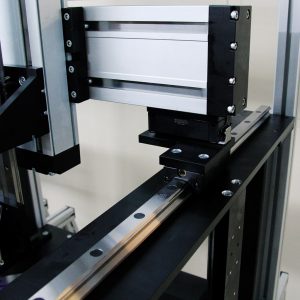
Linear ballscrews are used widely as a form of motion control, enabling linear movement out of rotational movement. Ballscrews are ideal for applications that require high levels of precision and control, and can be found in applications ranging from machine tools to flight controls in aerospace as well as in robotics and precision engineering.
What is a ballscrew and how does it work?
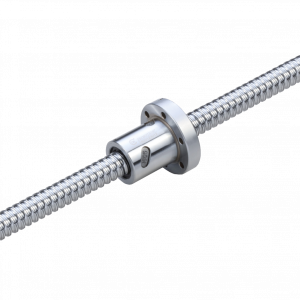
A ballscrew is a mechanical device – a linear actuator – that converts rotational motion to linear motion. A threaded shaft provides a helical path for ball bearings, allowing them to behave like a screw; the ball assembly acts as the nut while the threaded shaft is the screw. The balls roll between the nut and the screw in the grooves when either the screw or the nut rotates, providing linear movement in the form of a screw actuator.
Why choose a ballscrew for linear motion?
Ballscrew actuators produce minimal friction and are generally built to much higher tolerances than standard acme, or lead screws. This makes them well suited to high precision applications with a high payload. Linear ballscrews tend to provide the following benefits:
– Smooth movement
– Accuracy of movement and position
– Precision control
– Efficient output; smaller motors are needed thanks to lower levels of torque being required
– Continuous, high-speed movement
– Lower friction leading to cooler temperatures
Disadvantages of ballscrews
Ballscrews tend to be rather bulky due to the need to have a mechanism to re-circulate the balls. They also require braking systems to prevent back driving, which isn’t generally a problem with lead screws, their closest alternative. Ballscrews require some maintenance in that they need to be lubricated regularly, and are noisy in comparison to lead screws.
What are the main types of ballscrew?
The main areas in which ball screw actuators vary, other than the obvious size and load capacity options, are in relation to the method used for the return of the balls back to the top of the nut for recirculation:
Internal Return: The contained ball return allows the balls to exit the track and directs them into the next thread, returning the ball. It keeps the overall size smaller and provides higher accuracy. This option is less robust than the external return models, and are not ideal for high load or high speed applications. They tend to be used in delicate or high precision applications.
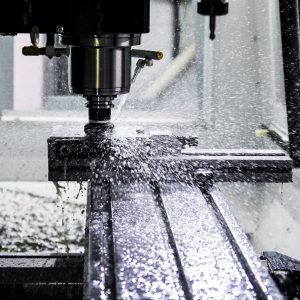
External Return: The ball return is external of the nut, usually by the means of a tube. This results in a larger footprint but allows it to be much better at dealing with heavy loads. Cleanliness and internal lubrication can be issues for these types of ballscrew. They tend to be used in high speed and/or high load industrial applications such as process automation or CNC machining.
End Cap Return: The balls are deflected by an end cap though a route bored transversely down the nut-body where the cap at the other end deflects the balls back into the threads. This type of ballscrew is generally quieter and cleaner than the other options and are therefore often used in food preparation and medical applications.
Ballscrews can also be categorised by the way that they are manufactured; rolled ballscrew threads are produced in a single process which is the more cost-effective production method. Ground ballscrew threads are made using machining centres to carve out the threads from material blanks and are then ground to produce a precision finish. Rolled ballscrews are generally less expensive and tend to have rougher finishes than ground ballscrews, which provide a much tighter precision tolerance and are both more accurate and more efficient.
Ballscrews from Matara
Matara offers a range of linear ballscrews in both ground and rolled options. Our ranges include:
SFE/SFNU internal return rolled ballscrew
SFH/SFNH high speed, low noise with dust proofing – rolled or ground ballscrew
BSH flangeless space saving rolled or ground ballscrew
SFM space saving rolled or ground ballscrew
SFY high speed, low noise with dust proofing – rolled or ground ballscrew
SFV high feed, heavy impact load, low noise ground ballscrew
DFM space saving ground ballscrew
DFS high speed, smooth performance and dust proofing option – ground ballscrew
OFI/DFI space saving ground ballscrew
OFU/DFU low friction, space saving ground ballscrew
OFV/DFV high feed, low noise ground ballscrew
We also provide a range of end supports in both fixed side and floated side formats, as well as ballscrew housing units.
If you would like to know more about the ranges of linear ballscrew available from Matara, take a look at our product pages or call one of our team on 01684 850 000.